• Branding
  • Marketing
  • Websites
  • Portfolio
  • Words
  • Let’s Talk
  • Menu Menu

ACS Honored with U.S. Marines Iraq Combat Flag

May 25, 2016

A Surprising and Humbling Gift from One of Our Favorite Clients

We’ve known U.S. Marine Lieutenants Polycarpe Depe, Emily Eckman and Bethanie Simms since they first decided to set up a charitable organization to support wounded U.S. service members and their families. It’s been our pleasure to create the website for The Org Foundation, and help out in any way we can.

We have been privileged to use our talents to benefit those who have served, fought and sacrificed to safeguard our priceless American freedoms. Every one of them deserve our thoughts and prayers. We certainly didn’t expect them to take time to think of us while on active duty!

Yet, that’s exactly what they did. And here’s what we received: a commemorative flag that was flown aboard a VMGR-352 Squadron aircraft in Iraq and signed by all the members of the flight crew! We will proudly display this flag in our office.

This Memorial Day, we ask all our friends, family, clients and partners to remember the service men and women we have lost … and make a donation to The Org Foundation or the service charity of your choice. Because we owe them a debt that can never be repaid. Thank you Depe, Emily and Bethanie for all you have sacrificed.

0 0 ACS Admin https://acsredux.acscreativedev.com/wp-content/uploads/2022/01/acs-logo-spot.svg ACS Admin2016-05-25 10:00:232016-05-25 10:00:23ACS Honored with U.S. Marines Iraq Combat Flag

Your Handy Dandy Designer Translator

May 19, 2016

20 Terms Often Heard from Website and Print Design Providers, Explained

At ACS, we always try to communicate with our clients in plain English, not insider jargon. But some words, phrases and acronyms are unavoidable when we’re explaining what we’re going to do for, or need from, them. So here’s our cheat sheet to help you get through your next designer conversation without batting an eye.

Website Design

Wireframe: A diagram of how a website’s pages will be organized. The wireframe should be approved by you before actual site building begins.

Responsive: A website that automatically adjusts to the screen size and shape it’s being viewed on.

Below the fold: The part of the website page not visible on screen unless the user scrolls down to it.

UI: User interface. The website design the user will see.

UX: User experience. How the website behaves, navigates and/or responds to user activity.

Print Design

Bleed: When the design calls for printed elements (i.e. photos) to go to the very edge of the page, we extend those elements 1/4″ beyond the trim line to allow for any slight slippages during trimming.

Gutter: The folded center of a brochure, catalog or magazine, where it’s hard to see type or images. The more pages in the printed piece, the wider the gutter becomes.

Type safety: For the same reason that we do bleed, all typography should be kept at least 1/4″ inside the trim line.

Images

CMYK, RGB: Systems used to reproduce an image in combinations of colored dots. CMYK (cyan, magenta, yellow, black) is preferred for print. RGB (red, green, blue) is used for websites. If a client provides an image in the wrong format, it may have to be converted.

Resolution, DPI: The number of dots per inch (DPI). For websites, 72 DPI will give you good quality. But for print, at least 300 DPI is required. If we used your website images for your brochure, the result would be as blurry as a newspaper photo from the 1940s.

Raster file: A photo or graphic design composed of dots or pixels. To display correctly, the raster file must be the exact dimensions required by the design. File types: .jpg, .gif, .png, .tif.

Vector file: An image NOT built out of dots. Vector files don’t have to be a specific size and can be enlarged without becoming grainy or distorted, so they’re ideal for multi-use graphics like logos. File types: .ai, .eps, .pdf, .svg.

COB, silo, silhouette: They all mean to cut out the background from an element in an image, such as the person in a photo or the shape in a logo. Usually done so that the element can then be layered onto a different background.

Text

Font: A specific typography design. When you buy a font, it will include upper and lower case letters, numbers, punctuation marks and symbols.

Kerning, tracking: Two words for the same thing: the space between the letters of a word.

Leading: The vertical space between lines of type.

Points, picas: Units of size measurement for lettering and spacing.
0 0 ACS Admin https://acsredux.acscreativedev.com/wp-content/uploads/2022/01/acs-logo-spot.svg ACS Admin2016-05-19 10:45:132016-05-19 10:45:13Your Handy Dandy Designer Translator

ACS Creative Launches Official Site of K-Rex Racing

May 18, 2016

ACS Creative launches the Official Site of Kaylen Frederick, the youngest open wheel Pro Racing Driver in the USA.

www.K-RexRacing.com

Born on 4 June 2002, Kaylen Frederick is the youngest open wheel Pro Racing Driver in the USA.

Kaylen’s racing in open wheel formula F1600 cars launched at PBIR & Sebring in February of 2016 at age 13. Kaylen Rex Frederick, known to friends as K-Rex, is the youngest open wheel Pro Racing Driver in the USA.

At the age of seven, Kaylen started his motorsport career, racing at Summit Point Karts. From there, six successful years in Karting followed, bringing us to season 2016, which sees Kaylen step up to single seaters and join Team Pelfrey for the F1600 Championship.

0 0 ACS Admin https://acsredux.acscreativedev.com/wp-content/uploads/2022/01/acs-logo-spot.svg ACS Admin2016-05-18 14:22:152016-05-18 14:22:15ACS Creative Launches Official Site of K-Rex Racing

Managing the Cost of Google’s Premium PPC Keywords

May 18, 2016

4 Tips for Most-Clicked Industries to Optimize Search Engine Marketing

Did you know that Google makes 97% of its money from pay-per-click (PPC) advertising? Through Google AdWords, a business can have its website appear on a search results page whenever the searcher enters the keywords the business has specified.

But the cost per click (CPC) of those keywords ranges from $0.05 to $50.00+, depending on their popularity. As you’ll see from the following list of top 10 most expensive keywords, certain types of businesses will unavoidably pay more for their Google search engine marketing (SEM).

The 10 Most Expensive Keywords

  1. Insurance
  2. Loans
  3. Mortgage
  4. Attorney
  5. Credit
  6. Lawyer
  7. Donate
  8. Degree
  9. Hosting
  10. Claim


But even if your business falls into one of these categories, you can reduce your SEM costs. Here are a few tricks of the trade.

1. Improve your AdWords Quality Score.

AdWords ranks your PPC advertising on the basis of its quality, relevance and performance. A higher score means a better position for your ads as well as lower CPC. So it pays to invest in keyword research, organize your keywords into highly focused groups, and write ads that will increase click-through rates.

2. Use long tail (3 to 5 word) keywords.

Making your desired search terms as specific as possible may reduce your total number of clicks, but will give you a higher percentage of clicks that lead to conversion. For example, you might specify “real estate attorney” instead of just “attorney” in order to avoid clicks from people seeking representation in a criminal case.

You also save money because the CPC of a keyword is determined by bid. A long tail keyword is likely to get fewer bids on it, so it costs less.

3. Specify negative keywords.

Negative keywords are the ones you DON’T want your ad appearing for. They might seem (to Google) to be related to your business or target audience, but any clicks you’d get through them are almost guaranteed to be a waste of money. For example, if you sell home equity loans, you might specify “auto loans” as a negative keyword.

4. Test your landing page.

When people click through in response to your PPC ad, is your landing page doing its job? Average AdWords conversion rate is around 2%, but you can do much better with a really effective landing page. The key is to test various offers to see what works best.


0 0 ACS Admin https://acsredux.acscreativedev.com/wp-content/uploads/2022/01/acs-logo-spot.svg ACS Admin2016-05-18 10:52:262016-05-18 10:52:26Managing the Cost of Google’s Premium PPC Keywords

5 Techniques to Determine if your Competition is Out-Marketing You

May 12, 2016

Keep Ahead by Keeping an Eye on Their Marketing Strategy

Monitoring the competition’s media presence is standard practice for big companies with mega-budgets for marketing analysis. But smaller businesses can also get in on the game with these 5 easy, cost-effective techniques.

1. Check out their website.

Watch for updates like product launches, added site capabilities and customer responses — anything that might indicate they’re getting a jump on you in terms of products and/or services. You might also notice things that aren’t working so well, and take advantage by offering your superior version to customers.

2. Follow their social media.

As a follower of their company pages on FaceBook, Twitter, LinkedIn, etc., you’ll be automatically informed of any marketing activity that takes place there (and how well it’s succeeding).

3. Monitor their activity internet-wide.

Through the free Google Alerts service, you can be notified of any online activity by your competitor that you specify, such as news, blogs and video posts. You can also choose whether to receive the alerts as they happen or batched daily or weekly.

4. Shop their products and services.

First-hand experience of how they deliver their brand shines a bright light on what they’re doing better than you, and vice versa. While you’re “shopping,” examine everything from product assortments and prices, to package design, to customer experience.

5. Receive their e-mail and direct mail promotions.

It’s easy to get your name on their mailing lists. Then everything they’re doing in these marketing channels will be delivered to your in-box for free. Through their website you can usually request the company brochures and other sales literature; or you can pick them up at the company’s trade show booth. (If you think you’ll be recognized, get an anonymous friend to do it.)

Consistency breeds success.

The key to these monitoring practices is to do them on a regular basis. You’ve probably noticed that they cost little or nothing in dollars, but you do need to invest a bit of time. The good news is that knowing your competitor’s marketing strategy gives you the edge in staying one step ahead.

0 0 ACS Admin https://acsredux.acscreativedev.com/wp-content/uploads/2022/01/acs-logo-spot.svg ACS Admin2016-05-12 13:19:242016-05-12 13:19:245 Techniques to Determine if your Competition is Out-Marketing You

Marketing Your Business: Don’t Leave Out LinkedIn

May 10, 2016

It’s Not Just for Job Seekers Anymore

“LinkedIn is for finding a job. What does it have to do with marketing my business?” You may well be asking this question if the last time you visited LinkedIn was to update your resume. LinkedIn has changed as much as Facebook, and now offers huge opportunities for businesses to generate brand awareness, leads and sales … at much lower cost than traditional marketing media. It all starts with a well-planned company page, which can:

Acquire customers.

A network of your current customers, employees, vendors and partners provides the same incredible, ever-expanding reach as FaceBook; but better, because all these connections are business-related. And you can expect more and faster conversions from prospects who learn of you through LinkedIn referrals and recommendations than other media.

Although not strictly necessary, you can drive even more interested traffic to your page with LinkedIn’s paid advertising. These highly targeted ads are seen by the decision makers who need exactly what you sell.

Develop partnerships.

Forging alliances with businesses whose products and services complement yours benefits both organizations, whether by referring customers to each other or by creating joint venture products. And there’s no better place to find such partners than LinkedIn, which makes it easy to check up on reputation, performance and customer base.

Build public relations.

Your company page needn’t (and shouldn’t) be limited to “about us” type information. You can incorporate a wide variety of content to attract attention, expand brand recognition, position yourself as an industry authority, manage public opinion … and ultimately increase sales.

To achieve this particular goal requires a bigger investment of time, because you must update your page consistently with new content. To maximize your return on this investment, consider LinkedIn’s sponsored updates program, which puts your posts in front of a specified target audience and is paid for on a cost-per-click basis.

Go where your customers are.

Marketing has always been about reaching customers where they live. In the 21st century they live online; so, to effectively market your business, you need to live there, too. And LinkedIn is one of the hottest addresses you can have.

0 0 ACS Admin https://acsredux.acscreativedev.com/wp-content/uploads/2022/01/acs-logo-spot.svg ACS Admin2016-05-10 12:29:032016-05-10 12:29:03Marketing Your Business: Don’t Leave Out LinkedIn

Taking Care of AACPM with a Website Designed to Help

May 5, 2016

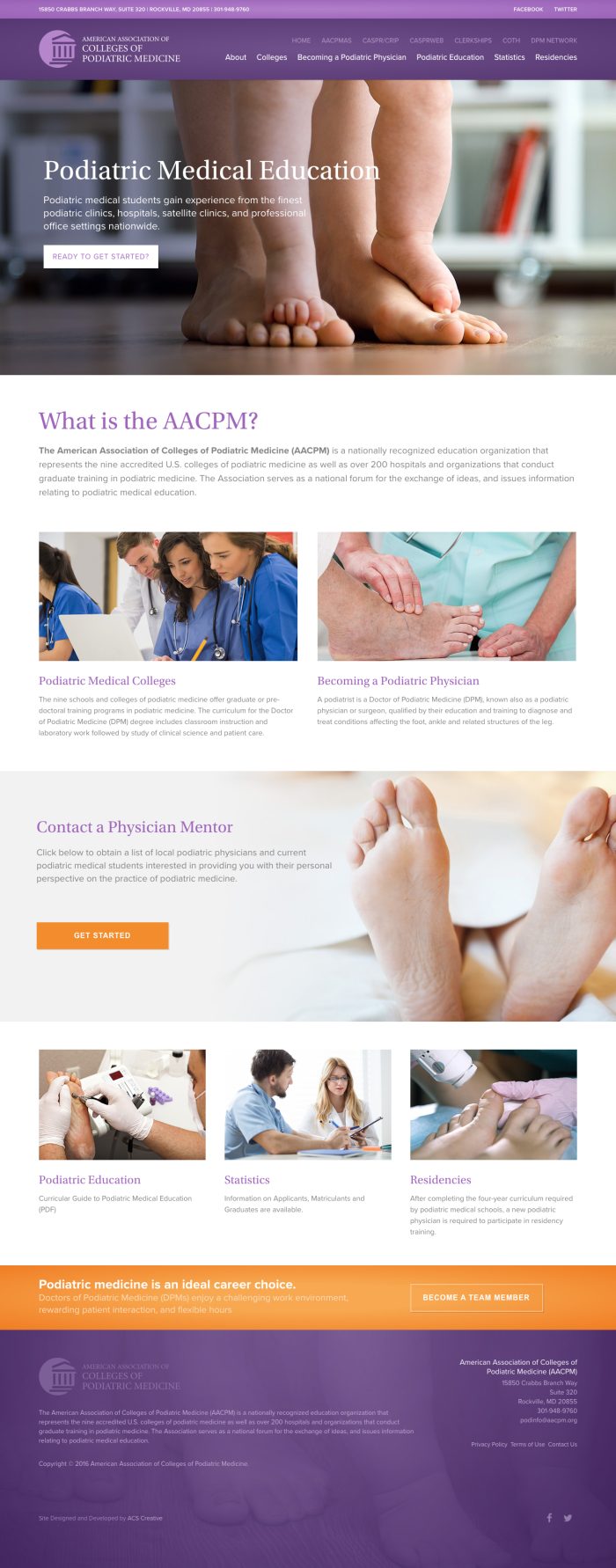
New site launch: AACPM

ACS Creative just launched the fresh new face of AACPM (www.aacpm.org), a nationally recognized education organization that represents the nine accredited U.S. colleges of podiatric medicine as well as over 200 hospitals and organizations that conduct graduate training in podiatric medicine.

The American Association of Colleges of Podiatric Medicine’s (AACPM) mission is to serve as the leader in facilitating and promoting excellence in podiatric medical education leading to the delivery of the highest quality lower extremity healthcare to the public. AACPM’s membership consists of nine podiatric medical schools and more than 200 hospitals and institutions that offer postdoctoral training in podiatric medicine. The Association serves as a national forum for the exchange of ideas, issues formation and concerns relating to podiatric medical education.

AACPM’s vision is to ensure, through collaboration and other appropriate means, that academic podiatric medicine is a vibrant community of schools and residency programs and other entities staffed with administrators, teachers and researchers capable of educating and training a podiatric workforce relevant to the needs of the public, generating new biomedical knowledge and providing academically based health services.

The AACPM administers several national service programs, including:

  • DPM Mentors Network: 
Assists interested students with locating a practicing podiatrists and current podiatric students for information about the profession.
  • AACPMAS – Centralized Application
: Centralized application service known as which processes all applications submitted for admission to the podiatric medical schools.
  • Clerkship Program: 
An online application and matching service for third year students applying for their third and fourth year clerkship rotations.
  • CASPR – Central Application Service for Podiatric Residencies: 
Application and matching service for fourth year students interested in applying for residency positions in teaching hospitals.
  • CRIP – Centralized Residency Interview Program
: The CRIP interview process provides a means of saving time and money as hospital faculty and residency candidates interview together in one major city during one six-day period in January each year.

AACPM staff also support the activities of the Association’s Board of Directors and several Councils representing member podiatric medical schools and residency programs.

AACPM is an Affiliated Organization of the American Podiatric Medical Association (APMA), which represents practicing podiatric physicians in the USA.


The American Association of Colleges of Podiatric Medicine

0 0 ACS Admin https://acsredux.acscreativedev.com/wp-content/uploads/2022/01/acs-logo-spot.svg ACS Admin2016-05-05 20:03:352016-05-05 20:03:35Taking Care of AACPM with a Website Designed to Help

Is Your Website Content Killing Your ROI?

May 5, 2016

Content Marketing the Wrong Way Loses Customers and Google Rankings

If your website isn’t getting the traffic and click-throughs it used to, it may be because your content is still playing by the old rules. Check out these 3 strategies that worked well once upon a time, before search engines and site visitors wised up.

1. Aiming for visitors, not sales.

This concept is a holdover from the heyday of passive income websites. The sole purpose of those sites was to be a billboard for banner ads, so the sole goal of the website content was to bring in the visitors to see the ads. The content on such websites was largely gibberish packed with the keywords (search terms) likely to be used by their target audience; but it achieved its goal.

However, this is not, and never should have been, the goal of a business website. If it’s going to pay for itself, you need conversions: visitors who will stay long enough to learn about and buy from your business. To do that, you need intelligible, useful content that keeps people reading. In any case, Google has changed its algorithms so that keyword-packed sites are now penalized by being kicked to the bottom of the search results pages.

2. Bulking up with weak or copied content.

Text for the sake of text, either purchased at cut rate prices from a provider who knows nothing about your business or simply plagiarized from another site, was once an accepted SEO tactic. Again, the mistake was assuming that increased traffic would automatically lead to increased sales. To be effective, content marketing must keep visitors engaged, informed and loyal. If they’re disappointed or bored with what they read, they’ll perceive your business as low value as your site. (Especially if they already read it on your competitor’s site!) Another thing to keep an eye on is the quality of the writing itself: spelling, grammar and syntax. You don’t want prospective customers to think that you dropped out of school in the 5th grade.

3. Setting it and forgetting it.

It used to be enough just to have a presence on the internet. The website was created and then simply left for people to find through search engines or links. But now that there are billions of sites competing for a share of audience attention, a static website will fall by the wayside.

Content marketing today means constantly providing new reasons for people to come back to your site. It could be as simple as a short weekly blog. Or having your tweets and Facebook posts automatically displayed on your site (and vice versa). If appropriate for your product, you could post how-to videos or user reviews. There are many ways to keep your content unique, fresh and valuable to your visitors.

That’s how content marketing builds brand recognition, generates sales leads and increases revenue … in short, delivers a great return on your investment.

Let’s chat about your next web project!

0 0 ACS Admin https://acsredux.acscreativedev.com/wp-content/uploads/2022/01/acs-logo-spot.svg ACS Admin2016-05-05 14:04:582016-05-05 14:04:58Is Your Website Content Killing Your ROI?

A Big Win for Google SEM: No More Sidebar Ads

May 3, 2016

A strategy adjustment is in order for SEM and SEO marketers

As you may have noticed, right hand sidebar ads have disappeared from Google. Instead, there are now up to four PPC (paid) ads at the top of the search results, where there used to be only two. This means fewer organic (nonpaid) results visible above the fold … and a new dominance for Google SEM ads.

It also means that updating both SEM and SEO strategy is essential. Here’s what our internet marketing experts are thinking.

SEO must aim for top 3, not page 1.

Once upon a time, if your website appeared in the first page of search results, you received the best click-through rates and your SEO efforts were deemed a success. Not anymore. Now the competition will be to appear above the fold, and the space available there for organic results has been reduced by the doubled quantity of paid ads.

Plus, the paid ads at the bottom are still there. So it’s harder than ever to even make page 1.

ROI of top position ads must be evaluated.

The new top positions are reserved for premium search terms, which cost more per click, so you need to be sure that the ad is worth the expense. To add value, Google has allowed more features in these ads that make them look like organic results, which are more trusted — and clicked — by users.

Another thing to consider: if your website receives top 3 placement in organic search results, there’s nothing to be gained by having a paid ad right above it.

The change must be kept in perspective.

  • Before the change, top PPC ads already received 85% of clicks. So the loss of sidebar ads won’t make a major difference in Google SEM returns.
  • Since the change, 78% of Google search results had less than the max of four top ads. So it’s far from inevitable that organic results will entirely disappear from above the fold.
  • This change only affects desktop views, and less than half of all searches are performed on desktop computers.

While it’s clear that SEO is now taking a back seat to SEM on Google, we believe that profiting from the new order is more a matter of fine tuning than a complete overhaul. If you’d like to discuss this further with one of our experts, please don’t hesitate to give us a call.

Definitions

  • Above the fold: The portion of a website page that you can see on your screen without having to scroll down.
  • Organic results: Nonpaid search engine results, usually the result of good SEO in a website.
  • PPC: Pay per Click. Online advertising format offered by Google Adwords and other search engines.
  • SEM: Search Engine Marketing. Paid ads on search engines like Google.
  • SEO: Search Engine Optimization. Building searchable features into your website in order to get high placement in search engine results pages.
0 0 ACS Admin https://acsredux.acscreativedev.com/wp-content/uploads/2022/01/acs-logo-spot.svg ACS Admin2016-05-03 17:04:482016-05-03 17:04:48A Big Win for Google SEM: No More Sidebar Ads

Pages

  • About Us
  • Branding
  • Home
  • Let’s Talk
  • Marketing
  • Portfolio
  • Privacy Policy
  • Websites
  • Words

Categories

  • Branding
  • Infinite Marketing Loop
  • Insights
  • Marketing
  • Websites

Archive

  • January 2022
  • December 2021
  • November 2021
  • September 2021
  • December 2020
  • October 2020
  • June 2020
  • March 2020
  • February 2020
  • January 2020
  • December 2019
  • November 2019
  • October 2019
  • September 2019
  • March 2019
  • November 2018
  • October 2018
  • September 2018
  • June 2018
  • May 2018
  • April 2018
  • March 2018
  • February 2018
  • January 2018
  • December 2017
  • November 2017
  • October 2017
  • September 2017
  • August 2017
  • July 2017
  • June 2017
  • March 2017
  • February 2017
  • January 2017
  • December 2016
  • November 2016
  • October 2016
  • September 2016
  • August 2016
  • July 2016
  • June 2016
  • May 2016
  • April 2016
  • September 2015
  • May 2015
  • June 2014
  • May 2014
  • April 2014
  • March 2014
  • October 2012
  • July 2012
  • June 2012
  • May 2012
  • April 2012
  • March 2012
  • February 2012
  • January 2012
  • December 2011

Award Winning Web Design, Brand Development & Online Marketing since 1986

We are web designers, developers, marketers and creative service strategists and our team can help you reach your goals through award-winning creative products. Discover more about our Company and our Culture.

Copyright © 2022 ACS Creative. All Rights Reserved.
  • Branding
  • Website
  • Marketing
  • Contact
  • About Us
  • Lets Talk
  • Privacy Policy
  • Facebook
  • Linkedin
Scroll to top